Launchpad Leaders: Wales’ Sea-snake Strikes – how Welsh Innovators are Harnessing Wave Power in the Celtic Sea
Wales is quickly becoming a hotspot for marine energy innovation, and at the heart of this momentum is the Lobe-Tendon Anaconda – an innovative wave energy converter developed by Checkmate Sea Energy (an affiliate of Checkmate Flexible Engineering), to reimagine how the power of the ocean can be converted into clean electricity.
Thanks to Launchpad funding from Innovate UK, the project has entered its most ambitious phase yet, accelerating development, expanding expertise, and turning years of steady progress into a fast-moving push towards sea trials.
To understand what this new phase means for the technology, JOMEC students spoke with Anthony McDonald, Project Manager at Checkmate Flexible Engineering, about the opportunities created by the funding and the future of the Anaconda.
Could you tell us more about Checkmate Flexible Engineering and its core mission within marine renewable energy?
Checkmate Flexible Engineering is primarily a rubber product manufacturer, supplying highly durable components to the marine, defence and industrial sectors from hovercraft skirts to large inflatable cargo-protection systems.
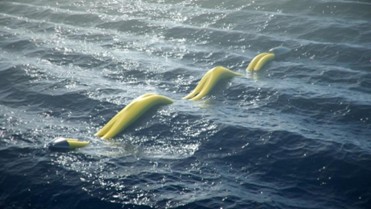
From this, Checkmate Sea Energy was formed as a specialist spin-out focused on developing the Anaconda wave energy converter, which is essentially a large inflatable rubber tube that harnesses wave energy to generate power.
What inspired the Lobe Tendon Anaconda technology, and could you explain in simple terms how it works?
The original Anaconda concept was developed by Rod Rainey and Francis Farley. They recognised that many wave energy converters at the time relied on large, rigid steel structures with multiple articulations, which made them expensive and complex to build and maintain. Their alternative vision was far simpler and more elegant: a large, flexible, inflatable tube that could store and transmit energy internally, rather than forcing loads through mechanical joints.
Inspired in part by dracone barges, the idea was to harness wave energy using a lightweight structure with significantly lower material and manufacturing costs.
In essence, the Lobe Tendon Anaconda captures energy from ocean waves by generation of pressure waves inside the tube. Ocean waves act like a vast natural battery, carrying energy generated by wind over long distances before delivering it to shore, even when the wind has stopped and the sun has set. Our device is designed to be “tuned” to those waves to increase the energy capture but can also be “detuned” in storms.
Checkmate Flexible Engineering has secured a £750,000 Innovate UK grant. What will this funding allow you to do that wouldn’t otherwise be possible?
The South West Wales Net Zero Industry Launchpad funding marks a major turning point for the Anaconda project. Before the grant, development was progressing steadily, but at a much slower pace due to limited by team capacity and access to specialist testing facilities. The funding will allow Checkmate Flexible Engineering to accelerate development, expand its team, and collaborate with expert partners across the UK, significantly increasing both the scale and quality of testing carried over the next 18 months through collaboration with expert partners.
What does this funding mean for the future of the Anaconda project? What milestones or breakthroughs are you hoping to achieve over the next 18 months?
The Launchpad funding doesn’t just accelerate progress, it sets the Anaconda on a clear pathway towards real-world deployment. Over the next 18 months, the team will deliver a development programme, taking the Anaconda from refined concept to readiness for its first sea trial.
The development includes creating a power take-off test rig to demonstrate how the pressure wave travelling through the tube can be efficiently converted into electricity, a vital step in raising the device’s overall technology readiness level. Alongside this, the team will conduct detailed material testing, particularly around fatigue life, to understand how long the inflatable structure can survive in harsh marine conditions. Improved numerical analysis tools will also be developed to increase confidence in predicting the device’s behaviour, with results feeding directly into performance predictions and future design decisions.
Ultimately, the goal is to progress to a sea trial.
How important is Wales – and South West Wales in particular – as a hub for marine energy innovation?
Wales, and especially South West Wales, plays a pivotal role in marine energy innovation, largely because the region has already done much of the hard groundwork that typically slows down early-stage development. The availability of funding at the right moment has been crucial, but just as important is the presence of the Marine Energy Wales META test site around Pembroke Dock. Having pre-consented test sites in place significantly reduces risk for developers like us. It means we can focus our efforts on advancing the technology itself, improving readiness and performance levels, rather than spending time and resources on site selection, consenting processes, and associated regulatory requirements.
The wider ecosystem in Southwest Wales amplifies these advantages. Existing infrastructure within META allows collaboration and integration that further de-risks projects, while the Pembrokeshire Demonstration Zone provides a pathway from sea trials to larger-scale deployment. Being able to partner with Swansea University and the Offshore Renewable Energy Catapult through MEECE brings invaluable local expertise and experience in marine renewables. Together, these factors make South West Wales not just a testing ground, but a genuine launchpad for marine energy technologies to move from concept to commercial reality.