Launchpad Leaders: Coating the Future — Inside Wales’ Journey Towards Better and Safer Hydrogen Storage
As the race towards net zero accelerates, low-carbon hydrogen is emerging as a crucial part of the UK’s clean energy strategy. South-Wales-based Creo International is helping to drive that shift, developing safer and more affordable hydrogen storage technologies that could support large-scale adoption.
Originally founded to build zero-carbon homes, Creo has evolved into a specialist hydrogen business. Today it designs low-carbon hydrogen systems, manufactures storage tanks, and is pioneering a world-first polymer coating that prevents hydrogen embrittlement, corrosion and leaks in tanks and pipes.
JOMEC students spoke to Neil Jenkins, Commercial Director at Creo International, about the company’s journey, the role of the South West Wales Net Zero Industry Launchpad funding, and how hydrogen could support Wales’ net zero ambitions.
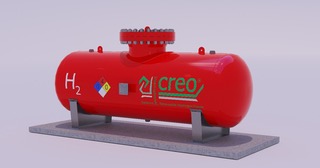
What is Creo International and how is the company innovating in low-carbon hydrogen technology?
Creo International began by designing homes powered entirely by solar low-carbon hydrogen, with the aim of eliminating energy bills while delivering exceptional energy efficiency.
To support this Creo created the Creo Block — our own ICF (insulated concrete form) of building block — which has enabled us to build nine homes with fast construction times and strong thermal performance. These are also manufactured in Wales.
Solar power alone couldn’t meet total energy demand, so we designed and integrated a low-carbon hydrogen system to provide electricity when there was a shortfall —electrolysers to produce low-carbon hydrogen and tanks to store hydrogen on site and convert it back into electricity through a fuel cell when needed. This allowed homes to generate surplus energy to sell back to the grid, without any gas or electricity bills.
As that technology developed, we shifted fully into low-carbon hydrogen, designing and installing low-carbon hydrogen systems for universities and test facilities. However, during this process, we struggled to source hydrogen storage tanks — supply was limited and expensive with long lead in times. So, we decided to start manufacturing our own at Pembroke Dock.
Why did Creo International begin developing polymer coatings for hydrogen embrittlement prevention?
Working closely with hydrogen storage systems made one challenge impossible to ignore: hydrogen embrittlement. Prolonged exposure to hydrogen weakens steel which can cause cracking with catastrophic results.
We wanted a preventative solution, not just risk management, so we developed a polymer coating that lines the inside of tanks and pipes, creating a protective barrier between hydrogen and steel.
How has the South West Wales Net Zero Industry Launchpad funding supported your hydrogen storage research?
We self-funded the early development of our tanks, including the first year of coating tests at Swansea University. However, as costs increased, the Launchpad funding allowed us to continue with Phase Three of the testing and accelerate progress. We have since built a new tank, applied the coating and cycled the pressure over a six-month period before carrying out acoustic emission testing, with very positive results.
How do you see hydrogen contributing to Wales’ net zero ambitions?
Hydrogen has a massive role to play. The biggest challenges right now are public awareness and funding. Many projects are led by SMEs, with limited buying power which keeps equipment prices high. However, buying in bulk will be key to reducing costs.
Another major advantage is being able to use coated carbon steel instead of stainless steel or aluminium, which makes a substantial difference to cost. Transportation is an obvious area for the use of low-carbon hydrogen. We’ve designed a hydrogen fuel station concept that we’d like to build in the future, although it was disappointing to see the government-backed plans for the HyHaul project in the M4 corridor cancelled. The next step will be hydrogen for heavy goods vehicles and building a proper refuelling network throughout the country with the proper co-ordination.
Aligned with Welsh Government’s hydrogen strategy, Rebecca Evans, Cabinet Secretary Economy, Energy and Planning, said: “The Welsh Government recognises the importance of hydrogen for decarbonisation, particularly for sectors that are hard to electrify, such as heavy industry and certain transport applications. We also recognise the significant economic opportunities the technology can deliver for industry, business and citizens in Wales.”
What are the next steps for Creo International’s hydrogen coating and storage tank technology?
The next step for us is securing International Certification of CreoCoat-H2. Once achieved, we’ll have a product with global potential. With plans for 100% hydrogen pipelines throughout the UK, including a proposed 128-kilometre steel pipeline from Milford Haven to Newport, protecting steel infrastructure will be essential.
We’re also developing higher-pressure tanks suitable for hydrogen refuelling stations in particular. We currently manufacture 40-bar tanks but aim to move up to 500-bar and certify the coating at those pressures. That would allow us to market Coated 40-Bar Tanks and Coated 500-Bar Tanks, as well as Creo-coated pipelines.
To scale the business, we’ll need substantial funding — for further testing, expanded manufacturing facilities, coating production and global marketing and sales.
Our aim has always been to create safer and cheaper ways of storing hydrogen to reduce the overall Levelized Cost of Hydrogen (LCOE).