Launchpad Leaders: A CWTCH for Clean Energy
What if the water we usually throw away could help power a net zero future?
Across industrial sites, contaminated wastewater is an unavoidable by-product — costly to treat and energy-intensive to transport. But what if that same water could be transformed into something valuable?
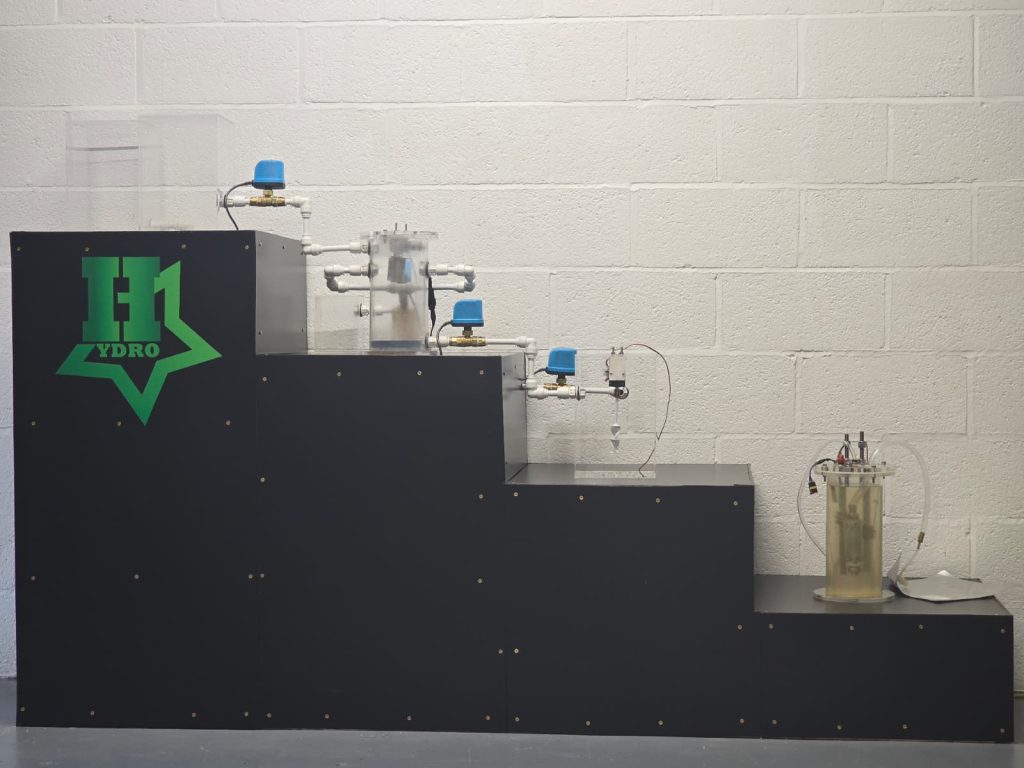
The CWTCH project is doing exactly that, exploring how contaminated wastewater can be used to produce green hydrogen while being cleaned in the process.
JOMEC students spoke to Mark Evans, Net Zero Project Manager at Wales & West Utilities, to learn more about CWTCH (Contaminated Water To Clean Hydrogen), a pioneering project supported by the South West Wales Net Zero Industry Launchpad.
Delivered in partnership with clean energy technology company HydroStar Europe and Cardiff University, the project brings together innovation, collaboration and a distinctly Welsh sense of ingenuity to tackle two environmental challenges at once.
Could you briefly describe the CWTCH project? What is it and what problem does it aim to solve?
CWTCH builds on earlier hydrogen demonstration work we carried out with HydroStar, which focuses on two key challenges facing green hydrogen production… water consumption and cost.
Conventional electrolysis requires ultra-pure water, which is relatively energy- intensive and costly for industrial sites to supply. At the same time, many industrial processes generate wastewater that must be treated or transported.
CWTCH aims to understand whether processed wastewater, even when contaminated, can be used to produce green hydrogen. If successful, the project could allow industrial sites to reduce wastewater treatment costs while producing clean fuel on site, addressing two environmental challenges at the same time.
How does the technology work, and how was it developed?
This technology differs significantly from conventional electrolysis systems. A key part of the process is electrocoagulation, which enables contaminants such as heavy metals and microplastics to be removed from wastewater before it enters the electrolyser.
The technology incorporates four core innovations:
- AI-controlled electrolyte management, allowing the system to adapt to varying water quality and fluctuating renewable energy inputs
- A redesigned electrolyser, which avoids the use of rare or precious metals making it more cost- effective
- Direct use of wastewater, significantly reducing the need for energy-intensive water purification.
- Electrocoagulation, utilises the electrolyser to simultaneously capture and remove microplastics, whilst generating green hydrogen and oxygen.
How has the funding from the South West Wales Net Zero Industry Launchpad created new opportunities for the project?
Launchpad funding has been instrumental. It’s allowed us to explore decentralised hydrogen production for industrial customers, opening up new opportunities for more sites to connect to the network and potentially inject hydrogen into it.
Support from Innovate UK and Net Zero Industry Wales has also helped us gain access to real world industrial wastewater samples, connecting us with organisations from South Wales that are willing to participate.
It’s also allowed us to work closely with HydroStar and Cardiff University, which carries out laboratory testing to understand how different wastewater streams behave in the system.
How could this project support Wales’ wider industrial decarbonisation goals?
One of the biggest benefits is the ability to use industrial wastewater directly, rather than relying on ultra-purified water. Avoiding that purification step significantly reduces electricity use and overall energy demand.
The project also shows how local, decentralised hydrogen production could support industrial users while strengthening energy resilience. Producing hydrogen within Wales reduces reliance on imported fuels and supports a more secure and sustainable energy system.
As part of our Launchpad-funded project, we also introduced additional infrastructure to skim contaminants from the water. This has enabled the removal of microplastics, nano plastics and metals, all of which are significant environmental concerns. These recovered materials can be recycled and reused, with metals potentially repurposed within electrolyser components and plastics diverted into recycling streams.
What’s next for the CWTCH project, and what excites you most about its future?
We’re currently in the process of finalising the project report and pulling together the learnings from this phase. From there, the focus will be on identifying the most appropriate funding mechanisms to support the next steps.
Our ambition is to scale up the demonstrator at an industrial site that directly uses process wastewater. Scaling beyond that will depend on future government regulatory and funding decisions.
What excites me most is the technology itself. It has the potential to be a real game changer, not only by significantly reducing the cost of green hydrogen production, but by creating additional value through the recovery and reuse of contaminants, which can help offset operational costs for industrial customers.
The hydrogen economy has developed slowly over the past decade, but it’s now accelerating. Technologies like this could fundamentally change how hydrogen is produced and used across Wales and the wider UK.